
The Pattern Underneath the Pattern
I've spent fifteen years building software. In that time, I've learned to pay attention to systems - how they fail, how they recover, how small repeated interactions compound into something much larger than any single event.
At some point I started noticing the same dynamics in myself (it look a hot minute).
Not in a dramatic way. More like: the same worry showing up in different clothes. The same tightness in my chest before certain conversations. The same impulse to check my phone when a feeling I don't like arrives. Loops, running quietly in the background.
I've tried a lot of things over the years. Journaling. Therapy. Meditation apps. Reading. All useful, in their way. But there was often a gap between understanding what was happening and actually feeling different when it happened again.
I built Somna to explore and capture that gap.
What actually repeats
Here's what I noticed: when I felt stressed or reactive, it was rarely about the thing in front of me. There was usually a deeper structure underneath.
Something happens (the trigger). A thought appears. Feelings rise. The body reacts - tight chest, clenched jaw, that familiar sinking. A behaviour follows - I scroll, I snap, I avoid. And underneath all of it, some belief gets quietly reinforced.
I'm not good enough. I'll be found out. I can't handle this.
The belief is the hinge. When something feels true at that level, your whole system organises around proving it. The thoughts, the feelings, the reactions - they're all downstream.
This isn't a flaw. These patterns made sense once. They were adaptations to environments that required them. The problem is they keep running long after the original situation has passed.
Why noticing matters
There's a concept in software called observability - the ability to understand what's happening inside a system by looking at its outputs. You can't fix what you can't see.
The same thing applies here.
Most of the time, we're inside the loop. The trigger arrives, the belief activates, the reaction happens, and we only realise later - if at all - that we were caught again. The pattern runs faster than our awareness of it.
But something shifts when you slow it down. When you can name the trigger, notice the thought, feel what's happening in your body, see the behaviour you're reaching for, and identify the belief underneath - the loop loses some of its power. Not immediately. Not completely. But gradually.
You're no longer just in the pattern. You're observing it. And observation changes things.
What Somna actually does
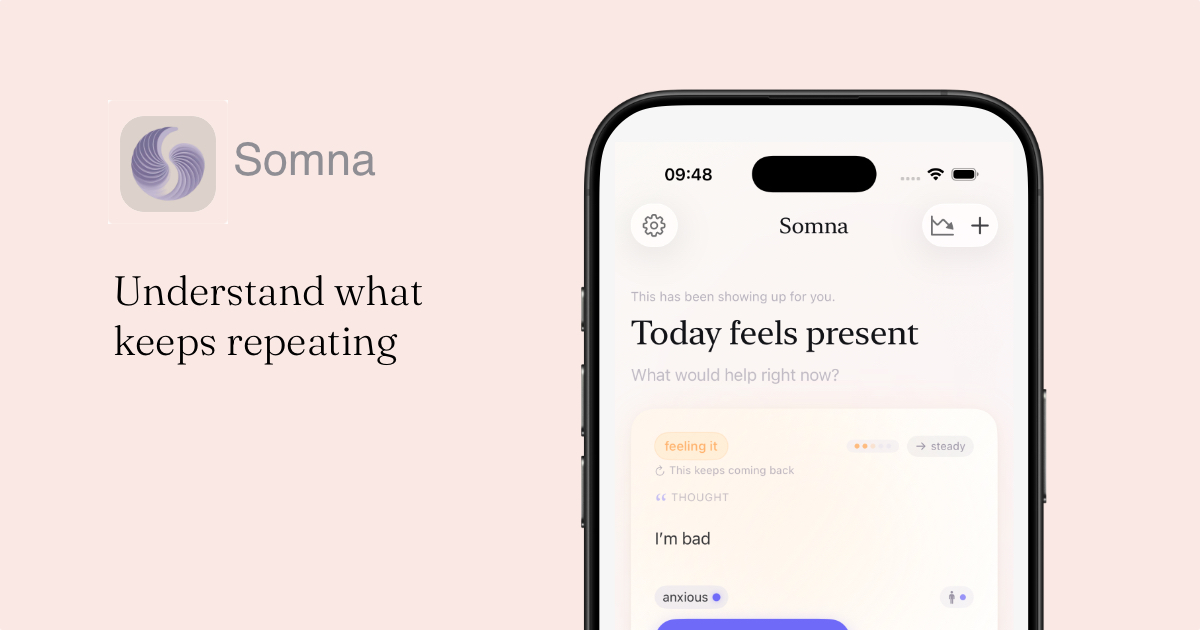
Somna is simple. When something's bothering you, you log it. The app walks you through each layer:
- What triggered this?
- What thought showed up?
- What are you feeling?
- What's happening in your body?
- What behaviour are you reaching for?
- What belief might be underneath?
Over time, you start to see what keeps repeating. Not because the app tells you - because you notice it yourself.
There's also a support mode for when things flare up. Simple breathing exercises, grounding techniques. Nothing complicated. Just ways to help your nervous system settle so you can think clearly again.
That's it. No streaks. No gamification. No guilt if you don't use it for a week.
What it isn't
Somna isn't therapy. It's not a replacement for professional support if you need it.
It's also not a productivity tool. There's no goal-setting, no habit tracking, no optimisation.
And it's not about fixing yourself. The framing matters here. You're not broken. Your nervous system learned to protect you. These patterns exist for a reason. The point isn't to eliminate them - it's to meet them with a bit more awareness, so they don't run the show quite so automatically.
Privacy as a feature
Everything you type stays on your device. I never see it.
This was a deliberate choice. The things you're logging are personal. They should stay that way. And honestly, you're more likely to be honest with yourself if you know no one else will ever read it.
Why I built this
The cynical answer is that I built it for myself. I wanted a tool that matched how I actually think about this stuff - patterns, systems, loops - without the aesthetic of most wellness apps.
The less cynical answer is that I think a lot of people understand their patterns intellectually but still feel hijacked by them emotionally. That gap is frustrating. You know the thought isn't true. You know you don't need to react this way. But knowing doesn't seem to help in the moment.
Somna is my attempt to bridge that gap. Not by adding more knowledge, but by building the habit of noticing - right when it's happening.
The long game
Loops don't break. They soften.
Each time you notice a pattern, name it, and meet it without judgement, it loses a little charge. Not overnight. Not permanently. But gradually, like a well-worn path slowly growing over because you stopped walking it so automatically.
That's the bet Somna makes. Not that you'll be fixed, but that you'll be a little more aware. And that awareness, compounded over time, changes something.
Somna is free to download on iOS. If you try it, I'd genuinely love to hear what you think.