
A Letter to My Younger Self Before Their First Talk
Dear 2013 me,
You're about to step on stage, or...stand up in front a bunch of web developers in London. Your heart's racing, you've had a gnawing feeling of dread in your stomach for the past week. Your mouth's a bit dry. That last cortado certainly did not help. You're wondering why you ever agreed to this.
Let me tell you a few things I wish you'd known before your first talk.
1. Your way of speaking is the point
You don't need to become a different person on stage.
You already have a mostly-measured, reasonably-thoughtful way of communicating. That is your style. Let it show. Audiences don't need another hype machine, that's not you - they respond to clarity, calm, and sincerity far more than polish. Making jokes is your ice-breaker, do that.
Trying to perform someone else's energy is exhausting. Speaking as yourself is sustainable.
2. The audience is just...you
Here's a secret: the room is full of nerds.
Curious, slightly awkward, well-meaning nerds who showed up because they want to learn something or be mildly entertained for half an hour. You're one of them - you've just been given a microphone. How would you keep yourself engaged?
They're not there to catch you out. They're on your side.
3. The first minute is always wobbly
That shaky feeling at the start? Completely normal.
Your body is dumping adrenaline into your system because it thinks you're being chased by a tiger. Ride it out. The fog clears. Your voice steadies. Your brain comes back online.
I promise: it passes every single time.
4. Change the question in your head
When nerves hit, your brain asks the worst possible question:
"Oh my god, everyone is looking at me."
Swap it for a better one:
"What do I want the audience to leave knowing?"
This reframes your role from performer under judgment to messenger with something useful. It pulls focus outward instead of inward - and that can calm your entire nervous system.
5. Time keeps moving (which is comforting)
Here's a sobering but oddly reassuring thought:
In 30 minutes - or an hour, or however long the talk is - it will be over. Completely done. Time doesn't pause to judge your slides.
There's usually a huge sense of relief when it ends. Then a strange little high. And, occasionally, a hint of sadness that it's finished - because once the fear drops away, it turns out...it's actually quite fun.
A final note
You're going to do absolutely grand.
Try - genuinely try - to enjoy it. This is a unique moment where you get uninterrupted attention to share something you care about. That's a privilege, not a threat.
You've got this. Stay weird.
- Ben
Talks I’ve Done (So Far)
I didn't start out confident on stage. I started out curious, slightly terrified, and hoping I wouldn't forget how to speak.
London, Aug 2013 - Will the Real DOM Manipulator Please Stand Up
FEL Front-end London
My first proper meetup talk.
A deep dive into modern JavaScript at the time - showing how native APIs were finally catching up with what jQuery had been abstracting for years. It was about demystifying the DOM, lowering barriers, and giving web developers confidence that they didn't need a library for everything.
Looking back, it was less about the DOM and more about finding my voice.
Bournemouth, UK, 2014 - iOS for Web Developers
re:develop Conference
This talk came from curiosity more than authority.
I was working as a freelance developer - deep in Node.js, JavaScript, and the front-end stack - and starting to get excited about iOS and what it unlocked. The goal wasn't to turn web developers into iOS experts overnight, but to show that the barrier to entry wasn't as high as it felt.
Different platform, same instinct:
reduce fear, build intuition, and make the unfamiliar feel approachable.
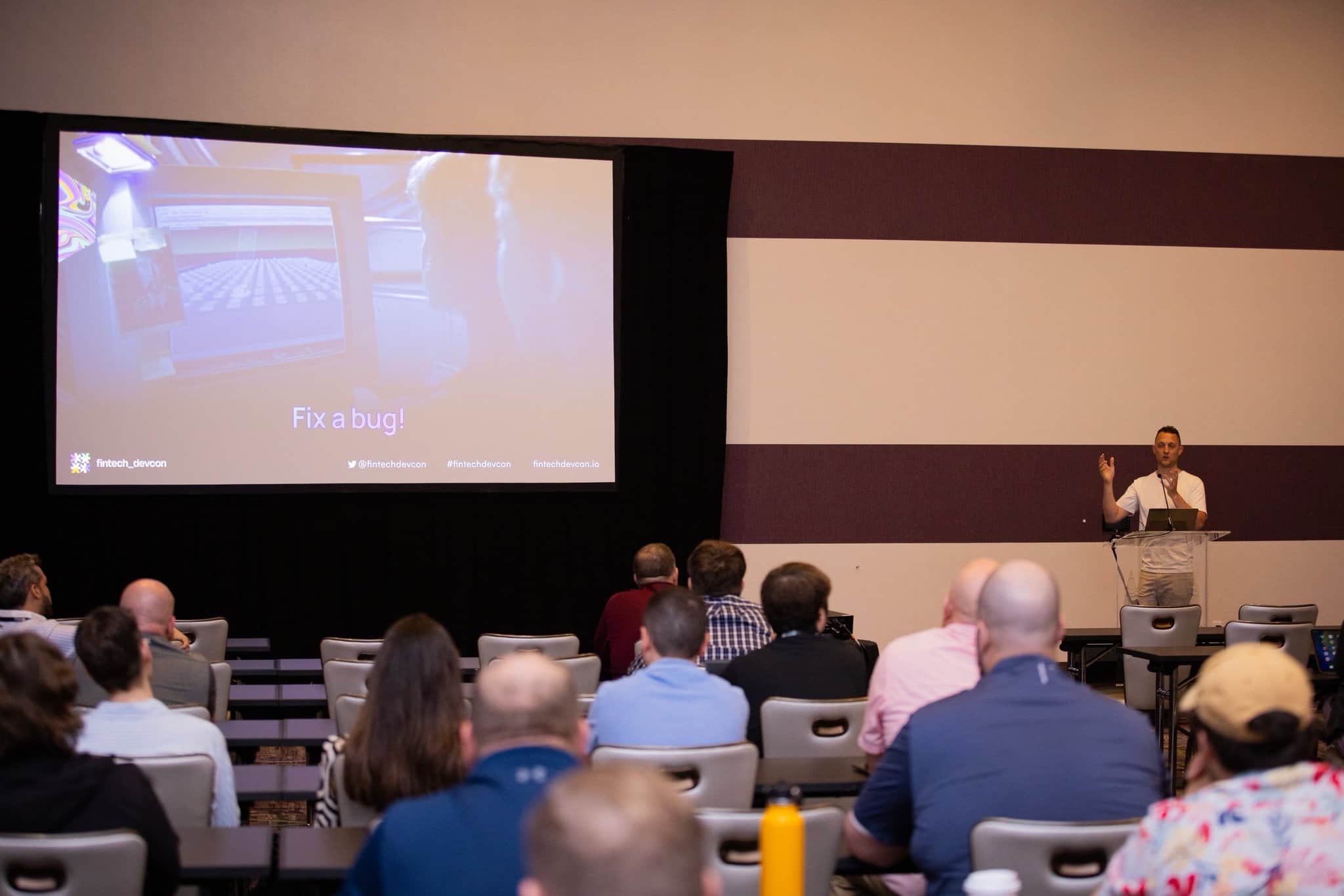
Austin, TX, Aug 2024 - Letting Go of Perfectionism in Distributed Systems
fintech_devcon 2024 · Roadblock Talk
By this point, the anxiety hadn't vanished - but it had changed shape.
This talk explored the mental models engineers use when designing large, imperfect systems: anticipating failure, managing tech debt, and resisting the urge to over-optimize for theoretical perfection.
Using Jurassic Park (specifically Ian Malcolm’s Chaos Theory) as a narrative lens, I talked about how overlooked details, unexpected actors, and brittle assumptions can bring complex systems down - and why resilience, observability, and graceful failure matter more than pristine architecture diagrams.
The committee feedback pushed me to make it more practical.
Denver, CO, Aug 2025 - Securing a Banking System’s UI & API
fintech_devcon 2025 · Roadblock Talk
This was the most grounded talk I've given so far.
Building on real systems I'd worked on as CTO at Letter and WorkMade - and later on Clerk's Commerce team - I focused on concrete security patterns that actually held up in production:
- Masking database IDs so internal structure never leaks
- Designing backends around auditability and defensive defaults
- Avoiding foundational security mistakes that are hard to unwind later
- Baking authorization directly into request handling using RPC + RBAC
The feedback this time wasn’t "add more examples" - it was "tell us what happened next."
What broke. What improved. What stuck.
That felt like progress.